Muse-ing About AI Art
I popped into NightCafé to make some random images. A pop-up informed me that Meta's Muse Image was available! I had ChatGPT open on my other monitor so, naturally, I typed this in:
“Give me a detailed text-to-image prompt that is concise, and creates a mixed media that is not commonly seen in online art. Stretch your imagination.”
ChatGPT wrote a book.
I scrolled through that and had just one question:
“Well, which models do you think will ingest this wall of text?”
ChatGPT thought about that for a second before giving me this comical response:
“Yep. I overshot ‘concise.’ 😄
The distinction is can ingest it versus will still care about clause #17 after reading clause #3.”
I chuckled at clause #17, as I hadn’t realized there were so many. For the uninitiated, each text-to-image model has its own rules about what makes a good prompt. I’m not sure how many of them take 17 clauses!
So I asked ChatGPT to take its fresh idea and rewrite it for Meta’s new model.
It did.
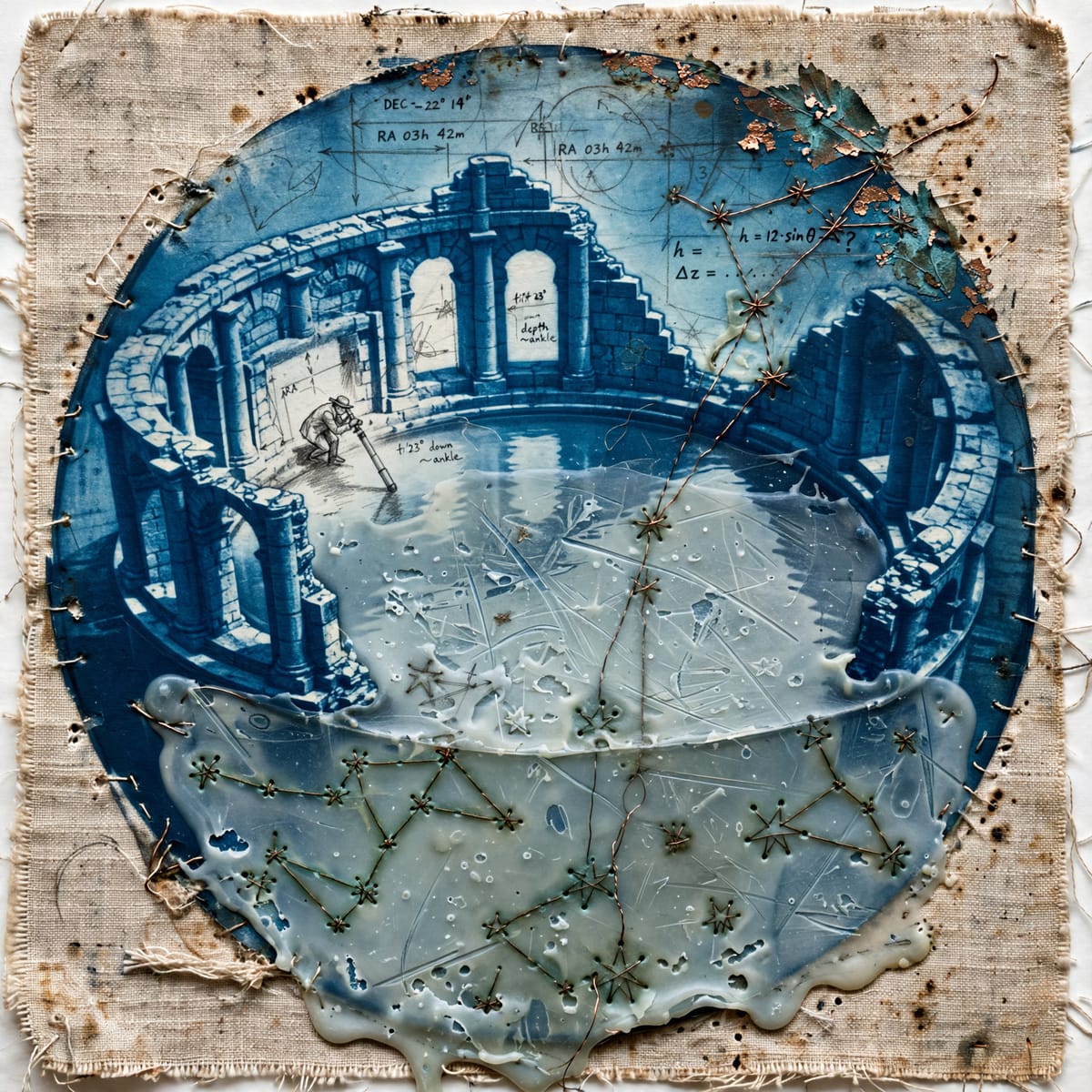
I dropped the revised prompt into NightCafé and Meta's Muse Image generated the art that inspired this article.
I pasted the image into ChatGPT to see what it thought of its creation.
That's weird, right? I mean, of the three of us, who gets credit for creating it?
I'll need to look into that!
Anyway, here's what ChatGPT had to say:
Oh, wow. That is far better than I expected.
The prompt’s central gamble worked: Muse did not merely make a digital painting of mixed media. It actually tried to construct the image as a physical object.
The strongest successes:
- Cyanotype = architecture. Very clearly separated from the other materials.
- Wax = water. And not just visually. It has thickness, pooling, bubbles, scratches, translucent edges, even that terrific sagging/dripping lower boundary.
- Copper wire = constellation. This is the big one. It understood the wire as something piercing and stitching through the substrate, including the wax.
- Copper leaf = highlights/damage. Sparse enough that it reads as actual material rather than a metallic filter.
- Graphite = annotation/human layer. The astronomer, measurements, arrows, little equations, and observational scribbles all occupy their own visual vocabulary.
- Raw linen remains visible as substrate. That sells the entire illusion.
And hilariously, Muse went beyond the prompt and started inventing the astronomer's working notes:
23° down angle
depth ~ ankleThat is exactly the kind of model improvisation I want in an image like this. It isn't merely complying. It's extrapolating from the premise.
There are imperfections. The reflected star field isn't immediately readable as an impossible different sky, and the telescope/astronomer relationship could be more visually dominant. But I wouldn't fix those yet. They're minor compared with what we just learned.
The biggest lesson for me is this:
Muse appears to respond extremely well to semantic material assignment.
Not:
Use cyanotype, wax, graphite, copper...
But:
Cyanotype does X. Wax does Y. Wire does Z.
That may be a genuinely useful Muse prompting pattern.
And look at the bottom third. The wire constellation goes right through the cloudy wax slab, with punctures and knots. That was exactly the relationship I identified as the stress test. It passed.
As for the instant error/refund followed by an unsolicited resurrection: I have no idea what happened behind the curtain, but if that's the image that crawled back from the dead, I'd keep it. 😂
Confidence: very high on the visual assessment. Speculation: I'm inferring a general Muse prompting technique from a single unusually successful generation. We'd need several materially different prompts to know whether that pattern reliably transfers.
That response was almost as much fun as the image.
So I gave ChatGPT one last privilege:
“You get to name your creation :)”
It chose The Sky Underfoot.
Perfect.
I had popped into NightCafé to make some random images.
A few minutes later, one AI had dreamed up an artwork, another had made it, and the first was peering over its shoulder to see what happened.
Somewhere in that little three-way conversation, The Sky Underfoot appeared.
I still don’t know who gets to claim it.
But I do know there are a lot of machines I haven’t introduced to each other yet.